If you are just getting up to speed on AARO, here is the short version: it is the Pentagon office that now handles UFOs, or UAPs if you prefer the official vocabulary. It was created to collect reports, review evidence, and tell Congress and the public what the government thinks is going on. On paper, that sounds overdue. In practice, it means the most sensitive UFO cases now pass through a Pentagon filter before they reach the public.
That is why AARO matters.
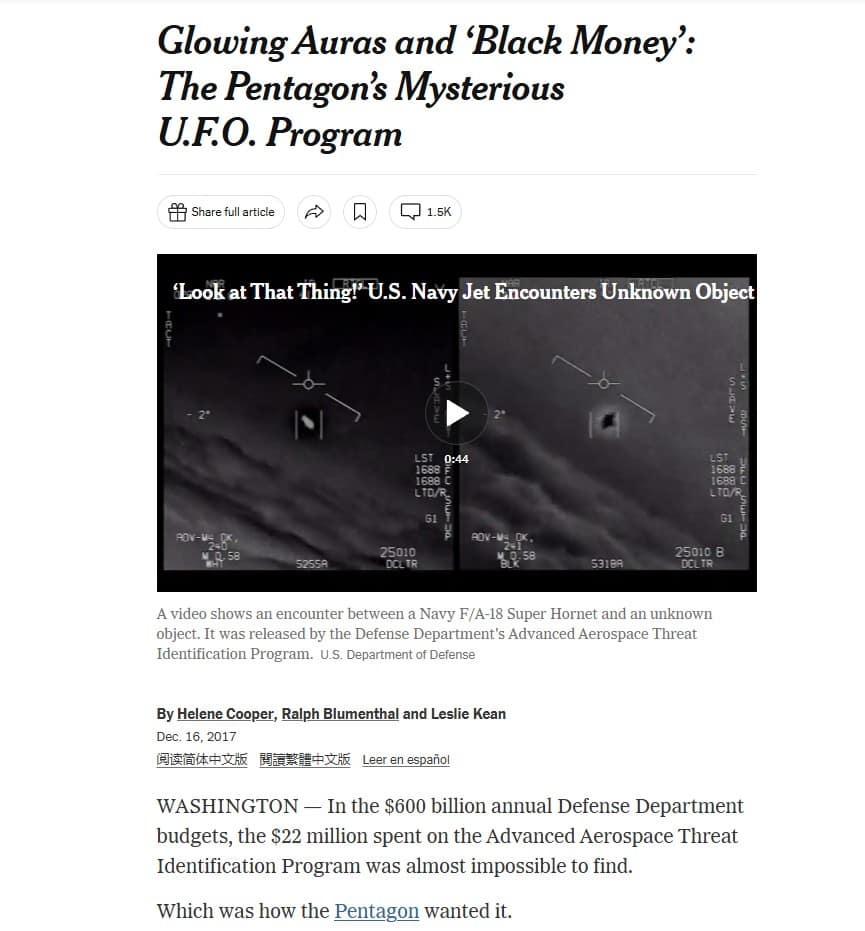
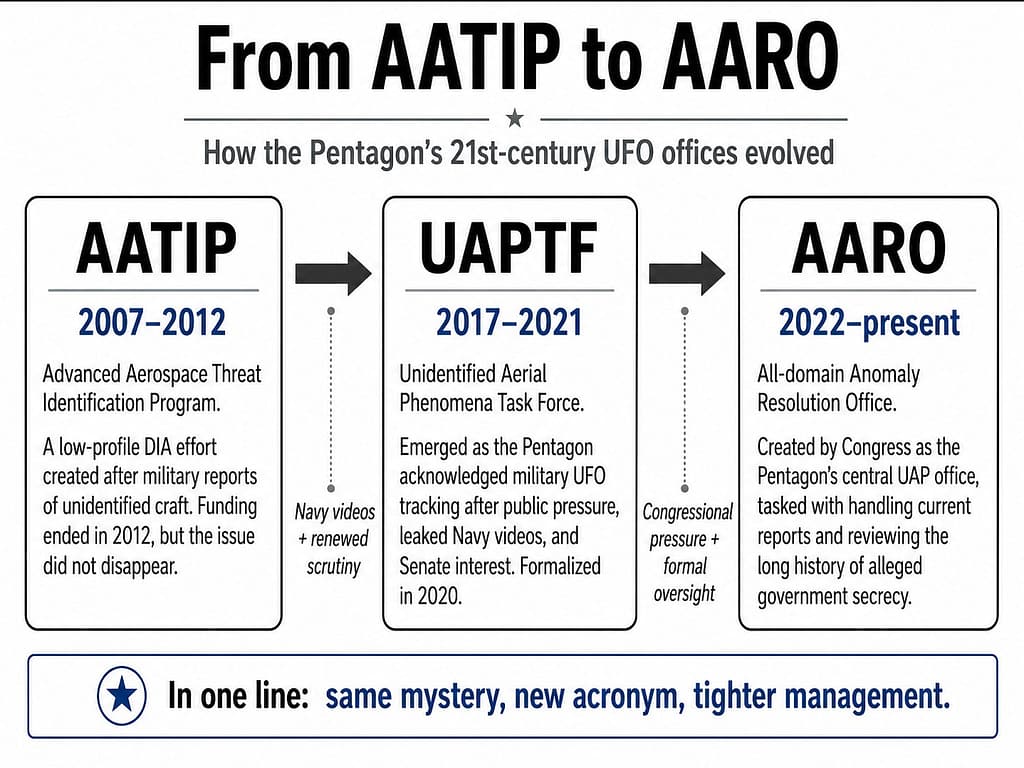
It also did not appear out of thin air. AARO is the latest stop in a twenty-year bureaucratic chain. First came AATIP, the Advanced Aerospace Threat Identification Program, launched in 2007 inside the Defense Intelligence Agency after military reports of unidentified craft became hard to ignore. AATIP was low-profile and underfunded, and by 2012 its funding was gone. The story did not end there. Navy encounters kept surfacing. Pilots kept reporting strange objects. Then in 2017, the subject blew back into public view when the Pentagon confirmed to the New York Times that it had in fact been studying military UFO incidents.
The Creation of AARO
That led to the UAP Task Force, or UAPTF, which was formalized in 2020 as Washington finally stopped pretending the issue belonged only to cranks and cable documentaries. Senator Marco Rubio and others pushed the matter as a national-security problem. Maybe the objects were foreign technology. Maybe they were something else. Maybe there was a boring explanation. The point was that the government needed to know. In 2022, Congress created AARO, the All-domain Anomaly Resolution Office, as the Pentagon’s central UAP shop. Same mystery, cleaner acronym, tighter management.
So what does AARO actually do?
Officially, it has two jobs. One is current casework: gather and analyze reports of unusual objects or events in the air, at sea, in space, and around sensitive military sites. The other is historical review: go back through decades of government involvement with the phenomenon and determine whether the United States ever recovered, concealed, studied, or reverse-engineered technology of non-human origin.
AARO’s public answer to that second question has been blunt. No hidden alien craft. No secret stockpile of exotic materials. No confirmed reverse-engineering program. Its historical review argues that much of modern UFO mythology grew out of a swamp of Cold War secrecy, misunderstood military programs, sensor problems, witness error, and the government’s long habit of saying as little as possible.
Some of that is almost certainly true. The Cold War produced a lot of strange aircraft and a lot of official lying. The military tested odd-looking platforms in deep secrecy. Pilots and radar operators did misread things. Civilians saw aircraft they were never supposed to know existed. If the Air Force let the public say “flying saucer” rather than “classified reconnaissance platform,” that was often a feature, not a bug.
But that is also where AARO starts to get slippery.

Its defenders tend to present it as a sober corrective to UFO hysteria. Its critics see something else: a bureaucratic system for taking raw anomalies and converting them into paperwork. A pilot reports something bizarre. Sensors pick up something odd. A case enters the system looking alive and unresolved. It exits as probable drone, balloon, atmospheric effect, sensor artifact, misidentification, or insufficient data.
Sometimes those explanations are right. Sometimes they are probably right. But “insufficient data” in particular has become one of those phrases that sounds neutral and functions like a dead end. The event is not explained, exactly. It is processed. It loses force. Public curiosity cools. The file goes quiet.
That is why the office deserves scrutiny. AARO is not an independent truth commission. It is not a civilian review board. It is not a team of reporters with subpoena power rummaging through defense-contractor basements. It sits inside the Department of Defense. It depends on the same defense and intelligence structure that controls the records, the sensors, the archives, the classification rules, and the release process. If the broader national security apparatus has been less than candid for decades, AARO is operating inside that architecture, not outside it.
This does not mean everyone at AARO is lying. That is the childish version of the story. The more serious concern is structural. If there were a deeply buried legacy program, the sort of thing whistleblowers and researchers have been alleging for years, would it appear neatly labeled in a database waiting for a new office to discover it? Or would it be buried under contractor custody, obscure program names, waived access, oral briefings, and the usual labyrinth of compartmentalized secrecy?
That is the problem in a sentence. AARO is supposed to investigate a mystery while working inside the institution accused of hiding it.
Enter Jon Kosloski
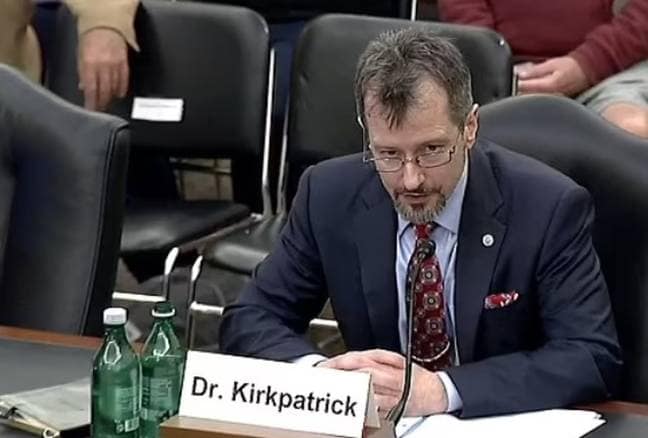
Its first director, Sean Kirkpatrick, embodied that tension. Kirkpatrick came out of the defense-intelligence world with the right scientific credentials and the right official language. He emphasized data, rigor, and evidence. He also spent much of his tenure feuding with whistleblowers, researchers, and some members of Congress. To skeptics, he was trying to clean up a circus. To disclosure advocates, he looked like the latest Pentagon official to acknowledge just enough to seem open while drawing the circle of acceptable evidence so tightly that the most explosive claims never quite make it inside.
Kirkpatrick is gone now, and AARO is under Jon Kosloski, whose background is more technical and less combative. That may help. A serious UAP office should be good at sorting radar returns from sensor noise and real threats from confusion. Better technical analysis is useful. Nobody benefits from lumping weather balloons, foreign drones, and genuinely strange cases into one giant paranormal stew.

Still, better software does not solve the core issue. The question is not whether AARO can identify ordinary objects more efficiently. It probably can. The question is whether it can ever get to the bottom of extraordinary cases when the best evidence is classified and the chain of custody runs through the very agencies under suspicion.
That is why people who follow this subject closely tend to see AARO less as a final authority than as a bottleneck. It is where reports go in, conclusions come out, and the public is asked to trust the process. Maybe the process is honest. Maybe it is incomplete. Maybe it is functioning exactly as designed. But when the government investigates itself, the result is never just a finding. It is also a message.
And AARO’s message so far has been unmistakable. Yes, the phenomenon is real enough to warrant an office. Yes, military personnel have seen things they could not identify. Yes, some cases remain unresolved. But no, do not jump to non-human intelligence. No, do not assume hidden programs. No, do not mistake a mystery for a disclosure event.
That may be prudence. It may also be containment.

The larger significance of AARO is not that it solved the UFO problem. It plainly has not. The significance is that the Pentagon now has an official mechanism for deciding how much of the problem enters public life and in what form. It can release a case, narrow a case, downgrade a case, or classify a case. It can tell you that something happened, while also telling you not to get too excited about what it means.
For readers coming fresh to the subject, that is the main thing to understand. AARO is not just a UFO office. It is the government’s current way of managing the UFO issue. It may do useful work. It may even clear away a lot of junk that deserves to be cleared away. But when the topic shifts from drones and balloons to real anomalies, hidden programs, or evidence the public cannot see, AARO stops being a neutral window and becomes part of the story itself.
For readers coming fresh to the subject, that is the main thing to understand. AARO is not just a UFO office. It is the government’s current way of managing the UFO issue. It may do useful work. It may even clear away a lot of junk that deserves to be cleared away. But when the topic shifts from drones and balloons to real anomalies, hidden programs, or evidence the public cannot see, AARO stops being a neutral window and becomes part of the story itself. The office was not designed to solve a mystery for the public. It was designed to ensure the Pentagon remains the only entity that controls its conclusion.