Welcome to UFO-Land
In Part One, we discussed the seismic shifts in the UAP conversation following the 2017 New York Times article. In this section, we review the history prior to 2017—the lore of flying saucers, angels and demons, magical airships, fairies, and leprechauns, all featuring strange visitors of unknown origins and supernatural powers. Just like Kabuki theater or commedia dell’arte, these stories follow a rigid framework: the encounter, the interaction, the exit, and the transformative aftermath. It is no accident if this sounds like Saul of Tarsus on the road to Damascus; that biblical narrative fits the paradigm perfectly. Across cultures and centuries, this sequence operates as a recurring motif, changing costume as the historical backdrop changes. The chorus changes, but the song remains the same. This recurring pattern is the basic architecture of what we might call UFO-Land.
However, navigating the landscape of “UFO-Land” requires caution. UFO-Land is not a single coherent field. It is a border territory where military history, religious experience, folklore, intelligence operations, pulp mythology, genuine mystery, grift, trauma, hallucination, and cultural wish-fulfillment all crowd into the same dimly lit carnival tent. Some of it is serious. Some of it is ridiculous. Some of it is ridiculous and serious at the same time. Like any tourist destination, it features sites well worth visiting, alongside street vendors, pickpockets, and con artists waiting to exploit the unwary. The trick is not to become either a believer or a debunker, but a disciplined traveler: alert, curious, unsentimental, and willing to admit that the map is incomplete.
For this reason, the lore has to be handled as lore. Not dismissed, not swallowed whole. The question is not simply “Did this happen?” but “Why does this type of story keep appearing?” Across cultures and centuries, the same basic pattern repeats: a strange presence appears, interacts, unsettles the witness, and leaves behind a changed person or a changed community. Human beings keep reporting contact with forces that seem intelligent, non-human, powerful, elusive, and somehow adjacent to the sky, the wilderness, the dead, or the forbidden edges of ordinary life.
The Ancient World: Sumer and the Anunnaki
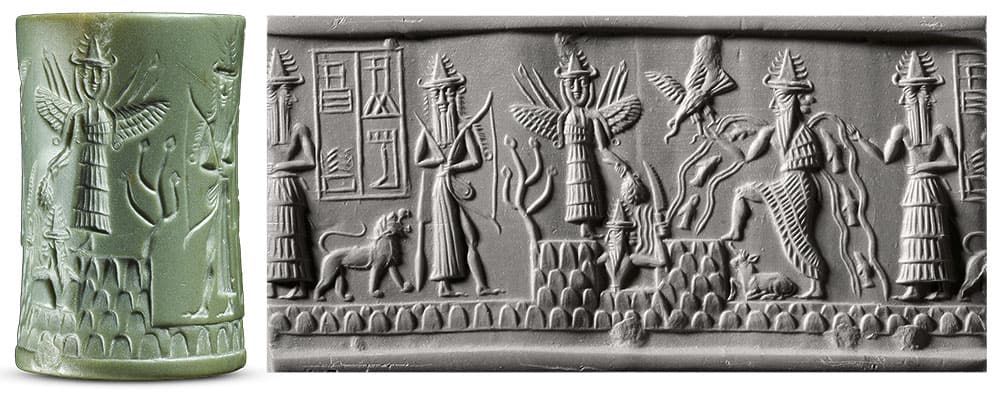
Like so many other aspects of our culture, the story begins in Sumer, the oldest known civilization on Earth. Cuneiform tablets unearthed from the Mesopotamian mud give us the Anunnaki. In the supreme pantheon of Sumer, Assyria, and Babylonia, these beings were literally “those of royal blood” or the offspring of An (the sky) and Ki (the earth).
Popular modern interpretations frequently trace the origins of these anomalous encounters back to the cuneiform narratives of ancient Sumer. While a conventional reading treats these records as mythology, the more interesting point is harder to dismiss: the earliest recorded human scribes did not frame the dawn of civilization as a purely internal triumph of human ingenuity. They framed it as a gift, intervention, or imposition from powers outside ordinary human life. That does not prove that the Anunnaki were astronauts, but it does place one of the oldest known stories of civilization inside the same recurring pattern: superior non-human beings descend, organize, command, teach, punish, and withdraw.
According to the tablets, the Anunnaki sat as a supreme council, decreeing the fates of humanity. More importantly, they were the custodians of the Me*—the physical, immutable divine decrees that formed the operating system of civilization. The *Me governed everything from technology, architecture, and metalworking to law, kingship, and religious ritual. Ancient cultures repeatedly imagined superior beings descending from above, systematically organizing human society, and shaping the cosmic order. It is one of the earliest recorded instances of human beings identifying an external, non-human intelligence as the source of civilization’s structure and authority.
The Judeo-Christian Tradition
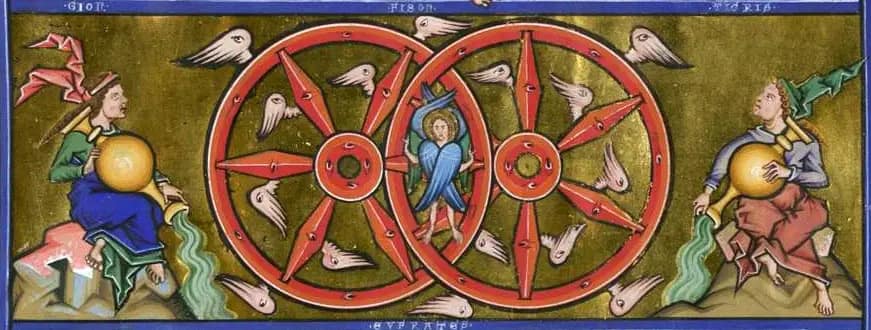
The Hebrew Bible gives Western culture some of its strongest contact imagery. Ezekiel’s Ophanim—the wheels within wheels, full of eyes, moving in impossible directions—are not little winged babies floating around a church ceiling. They are terrifying divine machinery. Whatever Ezekiel saw, imagined, received, or encoded, the image is closer to cosmic apparatus than greeting-card angel.
The Book of Enoch, an ancient Jewish non-canonical apocalyptic text heavily utilized by modern writers for its sweeping cosmic scope and dramatic narrative of celestial transgression, adds the Watchers and Nephilim: heavenly beings crossing the boundary into human affairs, mating with women, teaching forbidden arts, and corrupting the world. This matters because it introduces one of the deepest themes in the lore: contact is not always benevolent. Knowledge can be poison. The visitor can be teacher, predator, contaminant, or all three before breakfast.
Elijah’s chariot of fire continues the pattern: ascent, flame, vehicle, and a chosen man removed from ordinary death. It stands as a core component of the phenomenon’s early symbolic grammar.
India and the Vimana Tradition
To understand the global scope of this pattern, one must look to India’s epic literature. Within the Ramayana and the Mahabharata, the sky is populated by vimanas—flying palaces, celestial chariots, and aerial vehicles of immense power.
Unlike the symbolic clouds of Western antiquity, the texts of ancient India sometimes describe these craft with a strikingly mechanical and technical vocabulary. They are depicted as palaces or chariots moving through the sky, sometimes associated with metals, fire, wind, radiant force, or devastating weapons. They were not merely passive transports; in some accounts, they were weaponized platforms capable of firing beams of light that could incinerate entire armies.
From a comparative perspective, the vimana tradition belongs in this historical ledger for a deeper reason: it demonstrates that the association between supreme non-human power, atmospheric flight, and impossible technology is an enduring pattern that spans continents and millennia.

The Otherworld Problem
The UFO story is usually told as a story about things in the sky: lights, discs, triangles, cigars, spheres, metallic craft, impossible maneuvers. That is the “sighting” tradition. But there is another, older, stranger current running beneath it: the encounter tradition. Here the central question is not “What did people see?” but “Who—or what—did people meet?”
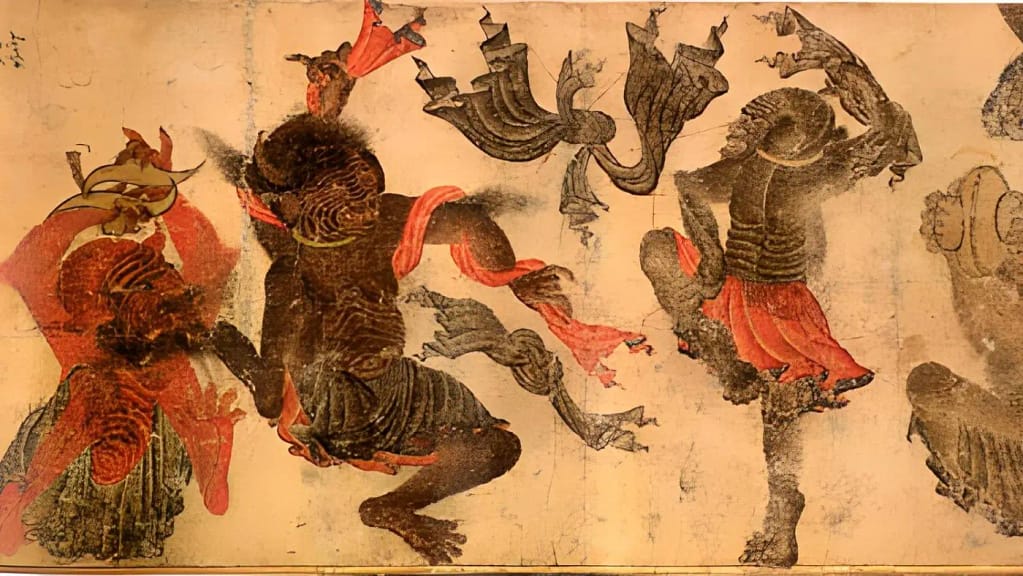
Not all visitors arrived from the sky. There were also angels, demons, djinn, fairies, elves, leprechauns, cloud sailors, hidden people, and the Good Neighbors. They lived in deserts, caves, hills, forests, ruins, islands, clouds, and invisible kingdoms beside our own. They abducted humans, stole children, distorted time, gave impossible gifts, punished disrespect, demanded secrecy, seduced travelers, and returned people altered, damaged, or not at all. Sound familiar?
The Islamic djinn are especially important here. They are not ghosts. They are not angels. They are a parallel order of beings: intelligent, powerful, morally mixed, often invisible, capable of interacting with humans, sometimes helpful, sometimes dangerous. That sounds uncomfortably close to later accounts of non-human intelligence that refuse to stay inside the neat box marked “extraterrestrial.”
Fairy lore has the same problem. People enter a hill, dance for what feels like a night, and return to find years have passed. Children are replaced by changelings. Travelers are lured off-road. Gifts turn to leaves. Time bends. The visitor lies, bargains, tricks, teaches, steals, and vanishes.
This is where Jacques Vallée becomes essential. Vallée is a French-born astrophysicist, computer scientist, and ufologist who helped build the first computerized map of Mars for NASA and later became one of the most sophisticated critics of the simple extraterrestrial hypothesis. His central insight was not that UFOs are fake, or that witnesses are fools, but that the phenomenon has existed throughout human history and behaves like a control system: something that shapes human belief, perception, mythology, technology, and social behavior over time.
That is what made Vallée dangerous to both camps. He bypassed the stale binary of believer versus debunker and looked instead at patterns: recurring encounters, absurd details, symbolic theater, impossible physics, shifting costumes, and the way the phenomenon seems to adapt itself to the culture observing it. In his view, UFOs look less like straightforward space travel and more like folklore with contemporary machinery bolted onto it.
Polymorphic Staged Encounters
The underlying reality here is that the phenomenon appears to be polymorphic—a shape-shifter. It changes form while preserving the same basic encounter structure. The mask changes; the pattern remains. In a religious age, it wears the skin of an angel, a djinni, or a demon. In an agrarian, rural age, it appears as the fae or the hidden people living inside hills and mounds. In an industrial age, it arrives as a goggled airship pilot. In a space age, it shows up as an extraterrestrial gray alien.
UFOs do not simply arrive; they stage encounters that manipulate human perception. They offer absurd details to match the expectations of the time. They behave like a control system, a theater, a mask shop, a haunted bureaucracy designed to condition human consciousness over generations.
So no, fairies and djinn are not simply “aliens” from a distant star system. That is the wrong reduction. The deeper anthropological point is that human beings have always reported contact with an adjacent intelligence: something near us, but not quite of us; something that enters ordinary life from the margins and behaves in ways that are simultaneously disruptive, symbolic, seductive, threatening, and often absurd. Modern UFO accounts do not replace those older stories. They update them, dressing the anomaly in the technological costume of the age: metallic hulls, glowing instruments, missing time, surgical tables, and gray humanoids.
The weirdness is not noise around the signal. It is the signal.
Medieval and Early Modern Sky Lore
In the ninth century, Agobard, the archbishop of Lyon, wrote against popular belief in Magonia, a supposed land in the clouds whose sky sailors stole crops. That is almost too good: cloud ships, aerial visitors, stolen harvests, angry peasants. Agobard was trying to crush superstition, but in doing so he preserved the superstition.
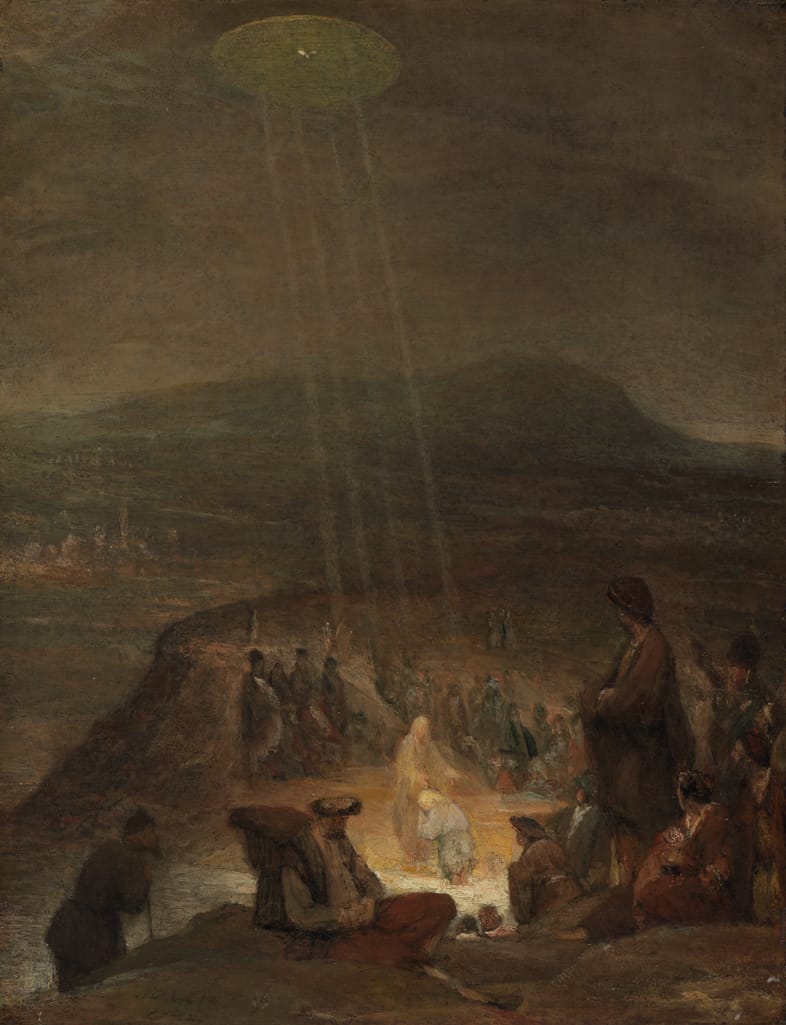
Renaissance art gives UFO-Land some of its favorite postcards: Madonna with Saint Giovannino, Crivelli’s Annunciation with Saint Emidius, and Aert de Gelder’s Baptism of Christ. Art historians usually read these through the lens of conventional religious iconography, rays of divine light, clouds, or halos. But UFO readers notice something else: the sky keeps functioning as the delivery system for revelation.
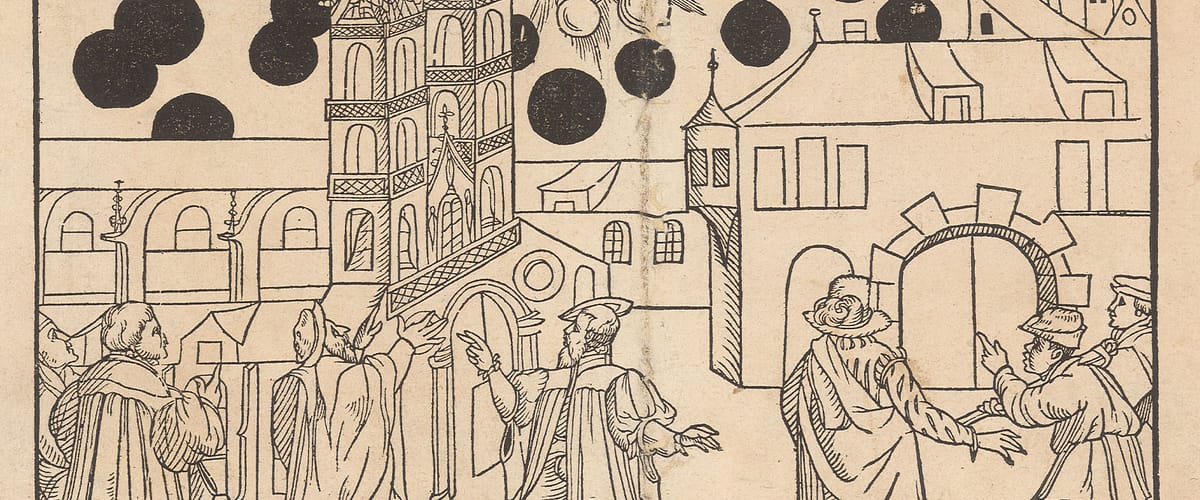
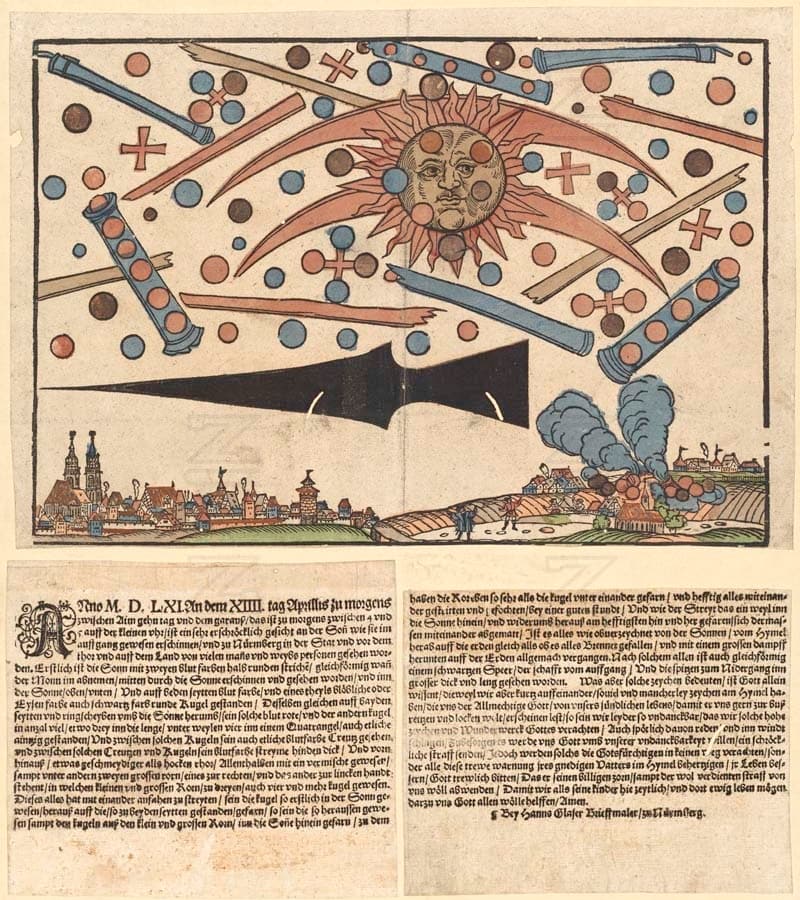
Then comes Nuremberg, 1561. Hans Glaser’s woodcut shows spheres, rods, crosses, cylinders, smoke, and dark aerial forms apparently battling over the city. Whether a meteorological event, a religious panic, mass interpretation, or something stranger, it is one of the great visual documents of premodern aerial anomaly lore.
Basel, 1566, follows with Samuel Coccius’ broadsheet showing black spheres over the city. Again, the key point is that these are sky events interpreted as omens, conflicts, warnings, or disturbances in the cosmic order.
In 1639, John Winthrop, the Puritan governor of the Massachusetts Bay Colony, wrote in his diary of a “Great Light in the Night” over the Charles River, reported by James Everell and two others, moving back and forth in the sky. It is often called America’s first UFO sighting. It shows the old pattern arriving in the New World almost immediately: settlers, wilderness, strange lights, official record.
The Great Transition: The Airship Wave of 1896–97
Finally, the Great Airship Wave of 1896–97 marks the formal transition into modernity. Before airplanes, Americans began reporting mysterious airships over California and the Midwest.
True to its polymorphic nature, the visitors were no longer described as angels, cloud sailors, or elemental spirits. Now that humanity was in the grips of the Industrial Revolution, the phenomenon put on a suit of gears and rivets. The entities were reported as inventors, pilots, and engineers—men with advanced machines who stepped out to request water or chat about mechanics.

Newspapers ran with it. Hoaxers piled in. Witnesses swore they saw craft. The whole thing had the distinct smell of modern UFO culture before modern UFO culture officially existed: technology, rumor, spectacle, fraud, wonder, and a public that badly wanted the future to arrive by airship.
That is the bridge into the twentieth century. First gods, then angels, then djinn, fairies, cloud sailors, sky battles, airships. Soon: saucers, crashes, bodies, radar returns, military witnesses, hypnotic regression, schoolchildren, and the permanent suspicion that someone in authority knows more than they are saying. The cultural matrix changes in each age but the fundamental narrative scheme remains intact.
NEXT: The Disclosure Era, Part 2B — The Twentieth Century.