
The Disclosure Era: From UFOs to Non-Human Intelligence — A Short Guide to the Post-Skeptical Age By Julian Virek
First, the ground rules. This chapter stays with what’s on the record: what happened, who witnessed it, and how the government answered. Facts that are documented get stated flat. Anything resting on a single witness, or still in dispute, gets marked as exactly that — no more. What it all means, whether any of it points to non-human intelligence, is a question for the later chapters. The work here is narrower and a good deal more boring: get the facts down, weigh them honestly, and leave them standing.
In this chapter
- 1947: Roswell
- 1952: Washington, D.C.
- 1952–1969: The Robertson Panel and Project Blue Book
- 1980: Rendlesham Forest
- 1994: Ruwa
- 1996: Varginha
- Adding It Up
1947: Roswell
In early July 1947, a ranch foreman named Mac Brazel recovered a field of debris on grazing land near Corona, New Mexico, and reported it to the sheriff in Roswell.
On July 8, 1947, the Roswell Army Air Field put out a press release. It said the base had recovered a “flying disc.” The release was written at the direction of base personnel and handed to the press by the public information officer, Walter Haut. The Roswell Daily Record ran it on the front page: “RAAF Captures Flying Saucer On Ranch in Roswell Region.” Roswell was then home to the 509th Bomb Group, the only nuclear-armed military unit in the world.
The account lasted about a day. General Roger Ramey, who commanded the Eighth Air Force at Fort Worth, called in the press, laid out debris, and identified it as a weather balloon with a radar reflector. Photographers shot Ramey with the material. That stayed the official line for the next forty-seven years.
Then it changed twice. In 1994 the Air Force issued a report attributing the debris to Project Mogul, a then-classified program of high-altitude balloons built to detect Soviet nuclear tests. In 1997 a second report took up the later accounts of recovered bodies and explained them as memory conflation: witnesses, it argued, had merged recollections of anthropomorphic crash-test dummies dropped in high-altitude experiments across the mid-to-late 1950s, along with a 1956 plane crash and a 1959 balloon accident, and folded that composite back onto 1947.
The bodies themselves are testimony, not record. They rest on witness accounts, most of which surfaced decades later, starting in the late 1970s, and some of which were afterward contested or withdrawn. They belong in the file as testimony of uneven provenance, not as established fact.
Strip it to what no one disputes and you get this: debris was recovered, the Army announced it had a disc, the Army took that back within a day, and then said nothing new for forty-seven years. When it finally addressed the body accounts, its answer was that numerous separate witnesses had fused events scattered across a decade into a single mis-dated memory of one night in 1947. Set aside whether that’s true. It is an explanation, but a strained one — and a strange amount of work for a story the government insists was always just a balloon.

1952: Washington, D.C.
Over two straight weekends in July 1952, radar operators at Washington National Airport and Andrews Air Force Base tracked unidentified targets over the Washington area, including airspace near restricted government corridors. The targets moved at varying speeds. Commercial pilots in the air reported lights that lined up with the radar returns.
The Air Force scrambled F-94 interceptors. On several approaches the objects left the area or dropped off the scopes; when the jets pulled away, the returns came back.
On July 29, 1952, Major General John Samford, the Air Force Director of Intelligence, held a press conference — the largest the Pentagon had called since the Second World War. He put the radar returns down to temperature inversions, a condition where layered warm air bends radar beams and throws back false returns.
The story ran nationally. The Washington Post’s Monday edition carried the line that stuck to the whole episode: “Saucer Outruns Jet, Pilot Reveals.”
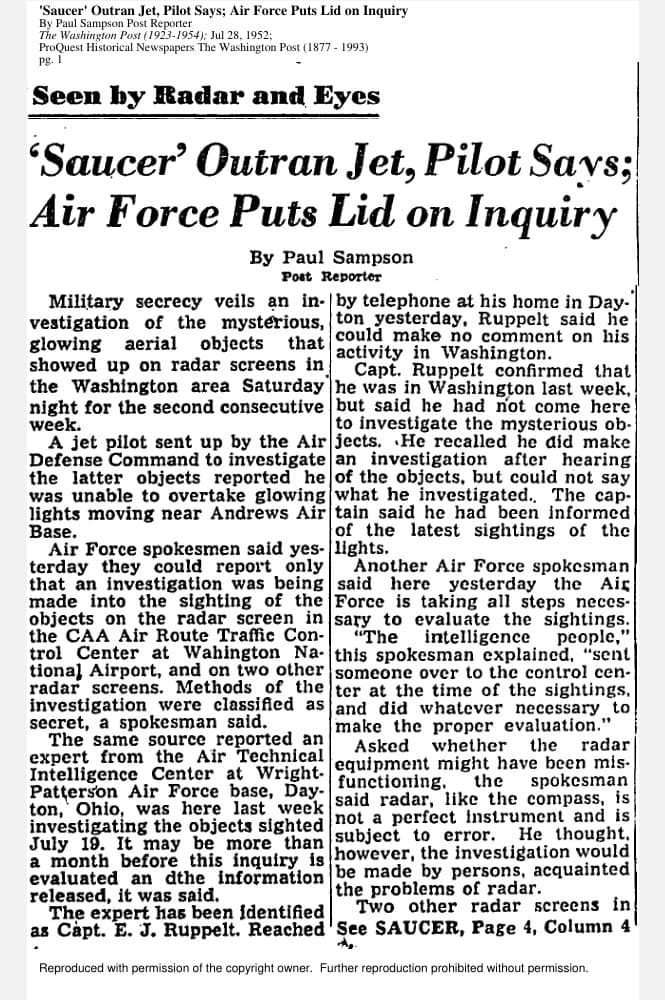
What’s solid: two separate installations tracked the same targets, jets went up, airline pilots reported lights where the radar showed them, and the official answer was weather. The inversion explanation drew doubt at the time from radar operators who didn’t think it accounted for the way the targets moved.
1952–1969: The Robertson Panel and Project Blue Book
The Washington flap didn’t just embarrass the Air Force — it spooked the CIA. Watching the capital’s own radar and communication lines swamped during those July nights, the agency saw a national-security hole: if the channels could be flooded with saucer reports by accident, they could be flooded on purpose, at the worst possible moment, by an adversary who wanted the early-warning system blind. So it moved fast. Barely five months after the radar nights, the CIA set in motion a panel of scientists chaired by the physicist Howard P. Robertson; it convened in January 1953 to go through the Air Force’s UFO data.

The panel found the reports posed no direct physical threat to national security. The risk it flagged was the volume of public reporting itself — the very vulnerability the summer had just exposed. To bring the volume down, it recommended a program of debunking and public education to strip the subject of its mystery, including the use of mass media.
Project Blue Book was the Air Force’s official UFO investigation. It opened in 1952 at Wright-Patterson Air Force Base. Its first director, Captain Edward Ruppelt, coined the term “Unidentified Flying Object.” The astronomer J. Allen Hynek served as its scientific consultant. Blue Book closed in December 1969, after the University of Colorado’s Condon Report concluded that more study wasn’t warranted.
Two documented facts carry this one: a federal panel recommended an organized campaign to reduce how often the public reported sightings — and how easily that reporting could be turned against the country — and the program built to field those reports ran seventeen years before it was shut down.
1980: Rendlesham Forest
RAF Bentwaters and RAF Woodbridge were twin bases in Suffolk, England, operated by the United States Air Force. They were nuclear-capable and widely reported to store tactical nuclear weapons, though that was never officially confirmed.
Just after 3:00 a.m. on December 26, 1980, a security patrol near the east gate of RAF Woodbridge reported lights coming down into the adjacent Rendlesham Forest. A small team went in, including Staff Sergeant Jim Penniston and Airman First Class John Burroughs. Penniston reported coming on a structured craft of unfamiliar material, marked with symbols. That part is his account — his testimony, and one whose detail expanded in the years that followed. Impressions were later found in the ground at the site.
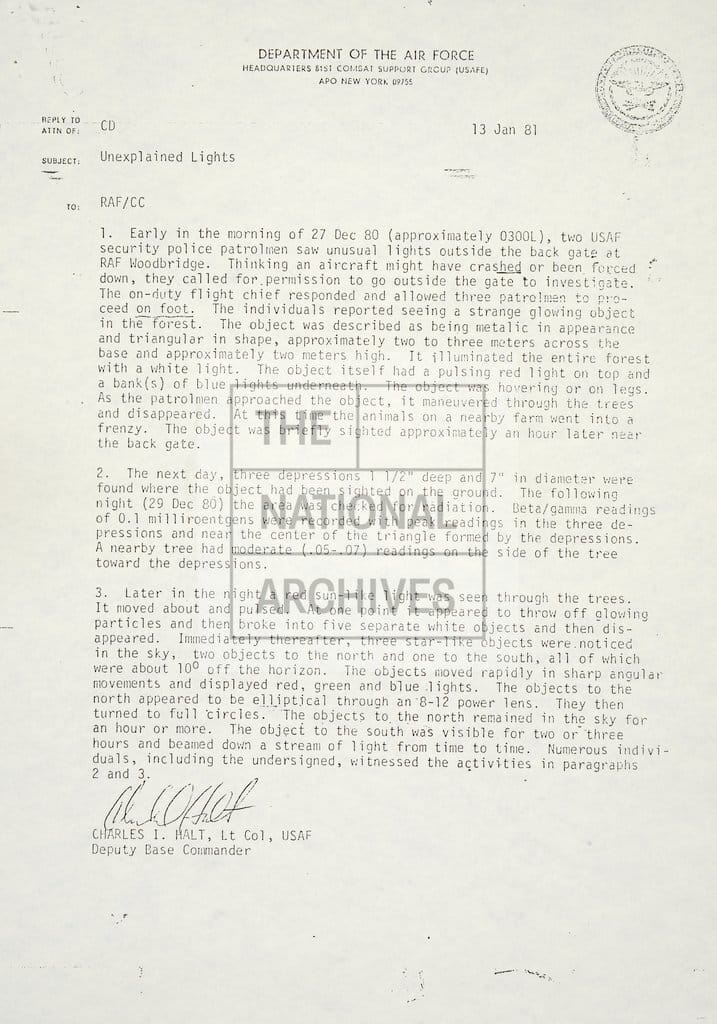
On the night of December 27–28, the deputy base commander, Lieutenant Colonel Charles Halt, took a team into the forest and recorded the investigation as it happened, on a handheld micro-cassette recorder. That recording — the Halt tape — is public, and runs about eighteen minutes. On it, Halt and his men take radiation readings, measure and photograph the ground impressions, and react to a flashing light in the trees. Halt later filed an official memorandum laying out what happened.
The Ministry of Defence’s position has been that the incident posed no threat to national security, and it judged the radiation readings logged at the site to be unremarkable.
What’s not in question here: trained military witnesses over more than one night, impressions in the ground, an official memo, and a tape a senior officer made on the spot that anyone can sit down and listen to today.
1994: Ruwa
On the morning of September 16, 1994, at the Ariel School — a private primary school near Ruwa, Zimbabwe — about sixty children were outside on morning break. The faculty were inside in a meeting. The children reported one or more disc-shaped objects at the edge of the schoolyard and one or more small figures in black near the tree line. The whole thing lasted around fifteen minutes.
Two days earlier, a bright fireball — later identified as the re-entry of a Zenit-2 rocket booster — had crossed the sky over southern Africa and drawn heavy radio and television coverage.
The children told their teachers that day and their parents that evening, and talked it over among themselves in the days before anyone came to interview them. The BBC’s correspondent in Zimbabwe, Tim Leach, filmed interviews at the school on September 19. The researcher Cynthia Hind interviewed children and collected their drawings on September 20. The drawings vary in detail from child to child, but a core image recurs across many of them: a craft, a small figure, large dark eyes. John Mack, a professor of psychiatry at Harvard Medical School, interviewed a number of the children in the months that followed and judged them sincere and consistent. The witnesses have largely held to their accounts into adulthood, in interviews recorded across the three decades since.
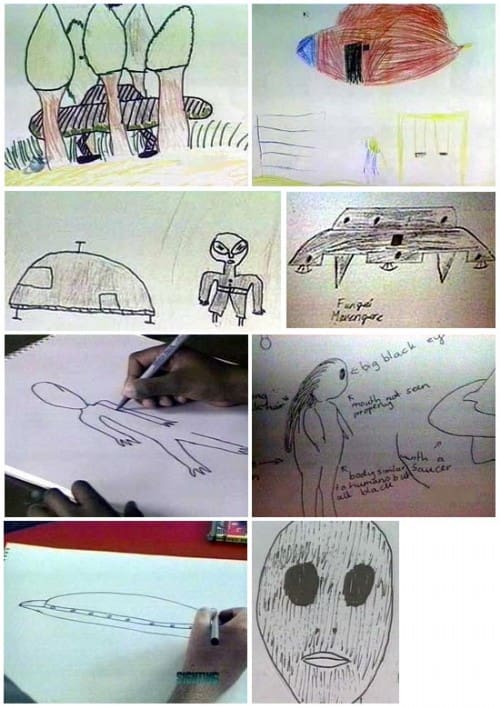
Here’s the part that holds: roughly sixty children, interviewed and drawing within days, and a single core image — a craft and a small, large-eyed figure — that recurs across many of those drawings and that most of the witnesses are still describing the same way thirty years on. They had talked among themselves first, and the details differ; the recurring core, and its durability, are what survive that.
1996: Varginha
On January 20, 1996, in Varginha, Brazil, three young women — Liliane de Fátima Silva, Valquíria Aparecida Silva, and Kátia Andrade Xavier — reported running into a creature in a vacant lot. They described it as small, with dark, oily skin, large red eyes, and bony ridges on its head, and reported a strong smell of ammonia. That’s their testimony, and they’ve given it consistently from the start.
Reports of a military and fire-brigade mobilization in the area, and of one or more entities being recovered, went around in the days that followed. Those accounts are mostly secondhand and were never officially confirmed. Reports of a crashed object the same day are fragmentary, and no wreckage was recovered. Treat all of that as contested.
Marco Eli Chereze, a military police corporal connected to the events, died on February 15, 1996, of a generalized infection following surgery. The recorded cause was post-operative sepsis. UFO researchers have tied his death to physical contact with the reported creature; the military stated he had no involvement with any such incident; his family disputed the official account and said they were denied complete medical records. What’s actually documented is narrow: a man connected to the events died of an infection weeks later, and the records around his death are incomplete. The link to the creature is inference, not record.
What you can stand on: three named witnesses whose account never moved, a death weeks later from infection, and a set of mobilization reports nobody official ever confirmed.
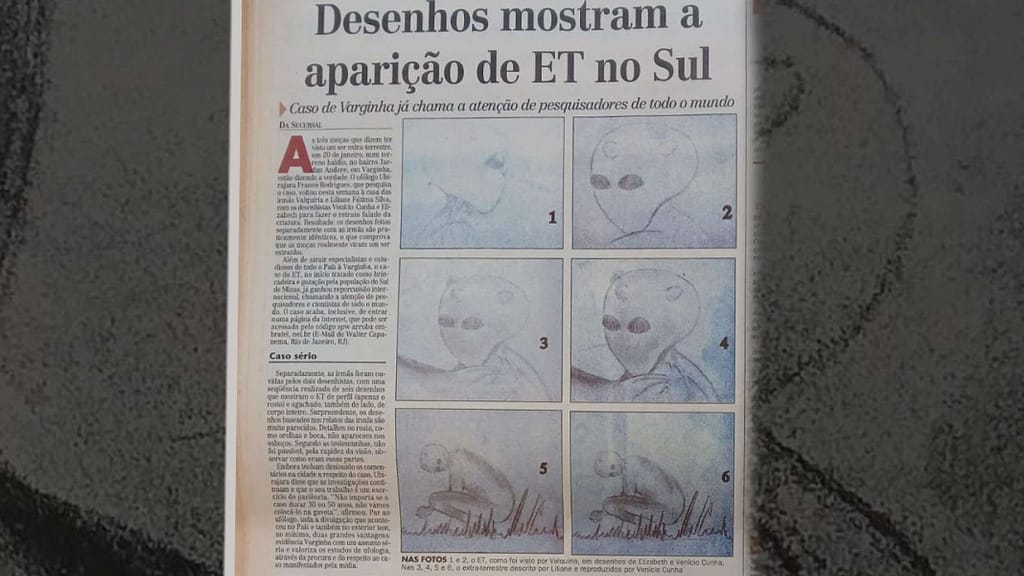
And then, thirty years on, the case drew the highest-ranking confirmation it has ever had. Aldo Rebelo — Brazil’s Minister of Defense from 2015 to 2016, and now a presidential candidate — stated on camera, in a filmed interview released in 2026, that Varginha was real and that a craft and non-human beings were recovered. Rebelo wasn’t in office in 1996; he spoke from his later access to the armed forces’ archives, and didn’t claim to have seen anything himself. He also vouched for the neurosurgeon who reported examining a living creature in a hospital bed, saying he believed the man. Days later, on June 9, 2026, U.S. Representative Eric Burlison cited Rebelo’s statement at a Capitol Hill press conference. Brazil’s government has issued no formal revision of its old finding. But a former defense minister affirming the case, by name, on the record, is something Varginha — and, for that matter, almost any case in this chapter — had never gotten before.
Adding It Up
Strip away everything that’s contested, and every one of these cases still leaves something on the table you can’t quite wave off. Roswell has a press release the Army put out and then scrambled to un-put-out a day later. Washington has the same unidentified targets lighting up two separate radar scopes at the same time. Rendlesham has a tape a colonel recorded in the dark, as it was happening, that you can still pull up and play today. Ruwa has sixty schoolchildren and one small, black-eyed figure that keeps surfacing in their drawings. Varginha has three women whose account hasn’t moved an inch in thirty years.
What any of it actually was — that’s not the question this chapter set out to answer, and I’m not going to pretend the facts close it. What they do close is narrower and a lot harder to dismiss: these things happened, people with names and reputations have stood behind them for decades, and the official explanations belong in the file right next to everything else — including the one where the Air Force asked a room full of witnesses to have somehow blended a decade of unrelated mishaps into a single false memory of one night in 1947.
And then there’s the part that, until almost yesterday, simply never happened. For most of a century, the people with the clearances said some version of nothing to see here. This year a former defense minister sat down in front of a camera and said the opposite — that one of these cases was real, that a craft and bodies were recovered, that he believed the doctor who stood at the bedside of a living one. The wall has held since 1947. This is the first time someone on the inside, at that height, has put a visible crack in it. Where that crack runs is the next chapter.