Part #1 – How We Got Here – From the 2017 New York Times Story to the Official U.S. Government UFO website
In this article
- The Ridicule Barrier Breaks (2017)
- The Navy Videos and the Tic Tac
- Official Ambiguity Replaces Official Denial (2020–2021)
- The Language Shift: UFO → UAP → NHI
- Four Congressional Hearings
- New Patterns: Undersea, Nuclear, Non-Human
- The Disclosure Era in 2026
- What’s Actually Being Disputed Now
by Julian Virek
This is not a story about whether UFOs are real. That question belongs to the pre-2017 world. The better question now is: what happens when the most powerful military, intelligence, scientific, and political institutions on Earth begin admitting that there is something in the sky, and possibly under the sea, that they cannot fully explain?
Since 2017, the UFO question has migrated out of tabloids, late-night radio, and fringe documentaries and into the machinery of the American state. It now lives in Pentagon offices, Navy flight-safety reports, intelligence assessments, congressional hearings, NASA studies, whistleblower testimony, classified briefings, and official release portals. The subject did not become simple, but it did become real.
The old debate was: Do you believe in UFOs? The new debate is: What are UAP, who knows what, what has been withheld, and why is the language shifting from “objects” to “non-human intelligence”?
The Ridicule Barrier Breaks (2017)
That shift begins, for the general public, on December 16, 2017, when The New York Times published the now-famous article “Glowing Auras and ‘Black Money’: The Pentagon’s Mysterious U.F.O. Program.”
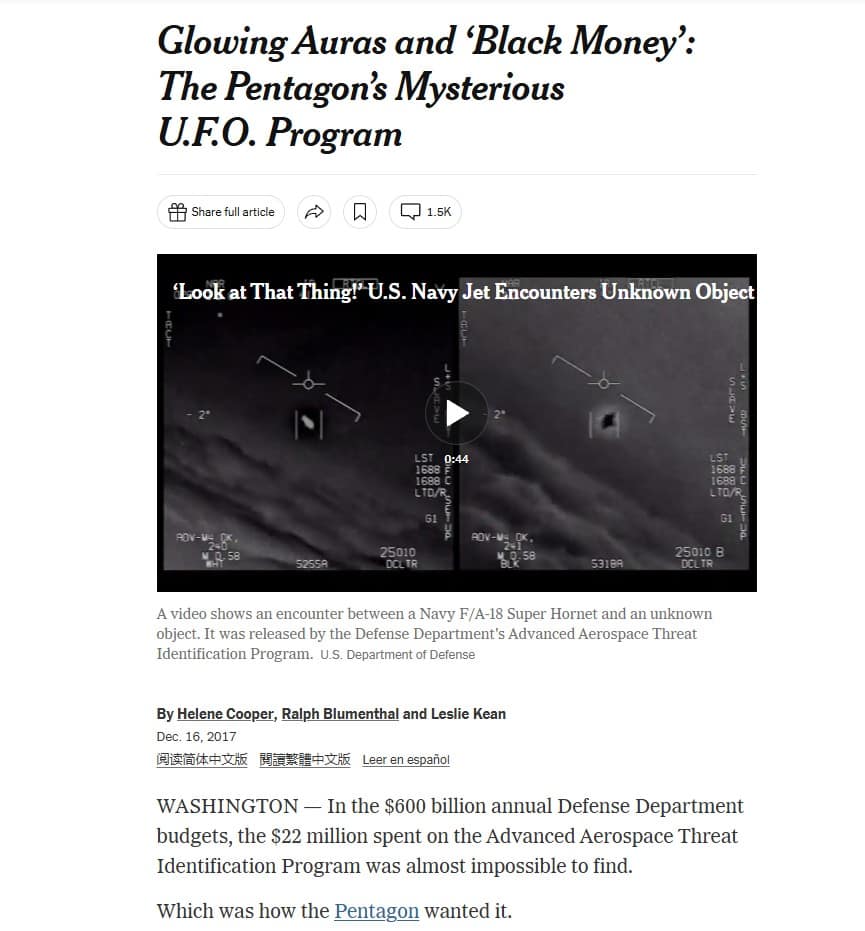
The story revealed that the Pentagon had funded a program known as the Advanced Aerospace Threat Identification Program, or AATIP, associated publicly with former Senate Majority Leader Harry Reid and former intelligence official Luis Elizondo. Contemporary reporting described it as a $22 million Pentagon effort begun in 2007 that examined military encounters with anomalous aerial objects.
The importance of the 2017 story is often misunderstood. It did not prove extraterrestrials. It broke the ridicule barrier.
For decades, UFOs were handled through a pattern of denial and mockery. The public was conditioned to associate the subject with cranks, cults, and unstable people. This was not an accident. The U.S. government had spent a great deal of time and money marginalizing public discussion of UFOs since 1947 — nearly eight decades. More on that year later.
Then suddenly in 2017, the story was not being carried by a supermarket tabloid. It was being carried by The New York Times, sourced to former officials, tied to Pentagon money, and accompanied by military video. That was the crack in the wall.

The Navy Videos and the Tic Tac
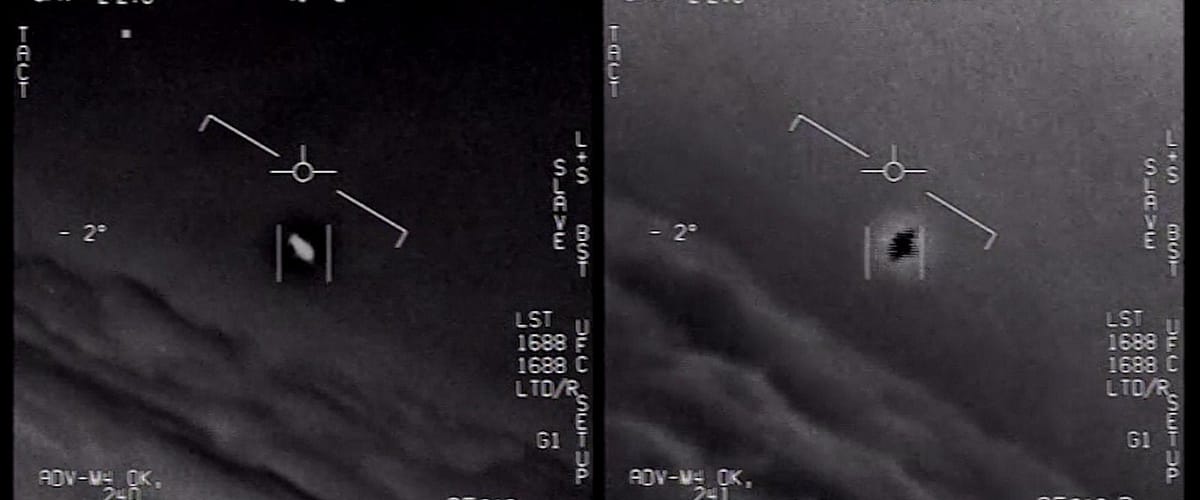
The videos mattered because they gave the public something it could see, even if they didn’t know what they were looking at. The now-famous Navy clips — FLIR1, Gimbal, and GoFast — showed encounters involving U.S. Navy aircraft and unidentified objects.
The 2004 Nimitz/Tic Tac incident and the 2014–2015 East Coast encounters became the central imagery of the new UAP era: grainy military sensors and objects behaving in ways that seemed to outstrip ordinary aircraft, drones, or balloons.
The 2004 Nimitz encounter. Navy pilot Commander David Fravor and other personnel described an object off the coast of Southern California that appeared white, smooth, oblong, and without visible wings, rotors, exhaust, or conventional propulsion. The object was tracked in the context of unusual radar contacts near the USS Nimitz carrier strike group. Fravor described it accelerating with extraordinary speed and behaving unlike any aircraft he knew, including extreme vertical acceleration — moving from near sea level to very high altitude in seconds.
The 2014–2015 East Coast cluster. Navy aviators operating near Virginia reported repeated encounters with anomalous objects during training flights — happening with such frequency that pilots put up homemade posters in the flight officers’ room joking that the first rule was not to hit them and the second was not to report them. The objects were described as Tic Tacs, orbs, or cubes inside spheres, and like the 2004 craft, they appeared to behave in ways that exceed our public understanding of physics and aerospace engineering.
Former Navy pilot Ryan Graves became one of the most important public witnesses because he reframed the subject away from ghost stories and toward aviation safety and national security. In 2023, Graves testified before Congress that such encounters were underreported because of stigma and that pilots needed a system for reporting what they were seeing without career damage.
The key point: after 2017, the subject quit being organized around “believers” and started being organized around credentialed witnesses inside military and government systems.
Commander David Fravor’s nearly two-hour interview on Joe Rogan is worth watching in full.
A civilian who sees a light in the sky has a story. A Navy pilot operating inside a military training range, with radar, infrared sensors, and classified reporting channels, creates a different kind of problem. The issue is no longer “what did someone think they saw?” It becomes: what did these military pilots see, who analyzed it, and why was the public told so little?
Official Ambiguity Replaces Official Denial (2020–2021)
In April 2020, the Pentagon formally released the three Navy videos that had circulated publicly after the 2017 reporting. The Department of Defense said it released them to clear up questions about whether the videos were real. That act marked another threshold crossed.
The government was no longer merely refusing to comment. Now it was confirming that the videos were authentic military imagery of unidentified aerial phenomena, even while declining to identify what they actually were.
The Pentagon did not say: “These are alien spacecraft.” It also did not say: “This is nonsense.” It said, in effect: these are real videos, taken by U.S. Navy personnel, and the objects remain unidentified. We went from official denial to official ambiguity.
Then came the intelligence reports. On June 25, 2021, the Office of the Director of National Intelligence released its preliminary assessment on UAP. The report reviewed 144 UAP observations, mostly from U.S. Navy reporting, and said only one could be identified with high confidence. It noted that some reports appeared to involve unusual flight characteristics, including objects that seemed to remain stationary in high winds, move against the wind, maneuver abruptly, or move at considerable speed without discernible means of propulsion.
The meaning was not that the government had confessed to alien visitation. The meaning was that the government had formally admitted the existence of a structured unidentified problem. That is a very different sentence from “people see things.”
The Language Shift: UFO → UAP → NHI
By 2021, the state had created a new public term for the phenomenon. “UFO” began giving way to UAP — first “Unidentified Aerial Phenomena,” then increasingly “Unidentified Anomalous Phenomena.” (The Department of War has since reverted to UFO on its official disclosure portal at war.gov/ufo.)
This was not cosmetic. “UFO” carried decades of cultural baggage. “UAP” was bureaucratic, clinical, and expandable. It could include objects, lights, sensor returns, transmedium events, space-domain anomalies, underwater or near-water phenomena, and things that do not behave like ordinary aircraft.
The terminology shift was one of the most important signs that the subject had changed category.
The next phase was institutional multiplication. Whenever bureaucracies begin expanding, you know something has become real. The Pentagon created more formal structures for UAP review, culminating in the All-domain Anomaly Resolution Office (AARO). NASA convened an independent UAP study team and released its final report in 2023, emphasizing that UAP should be studied through rigorous data collection, better instrumentation, reduced stigma, and more systematic scientific methods.
NASA did not endorse extraterrestrial conclusions. But its involvement changed the social status of the subject. A topic once treated as career poison was now officially worthy of scientific procedure.
Four Congressional Hearings
From here, the story stops being a simple chronology and becomes a series of institutional thresholds.
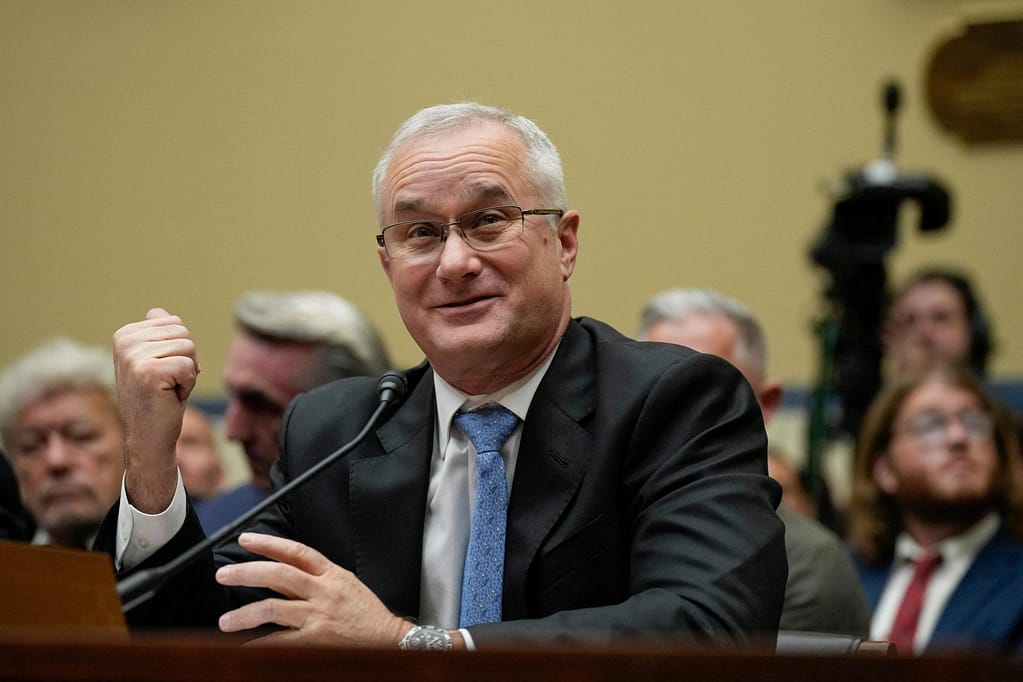
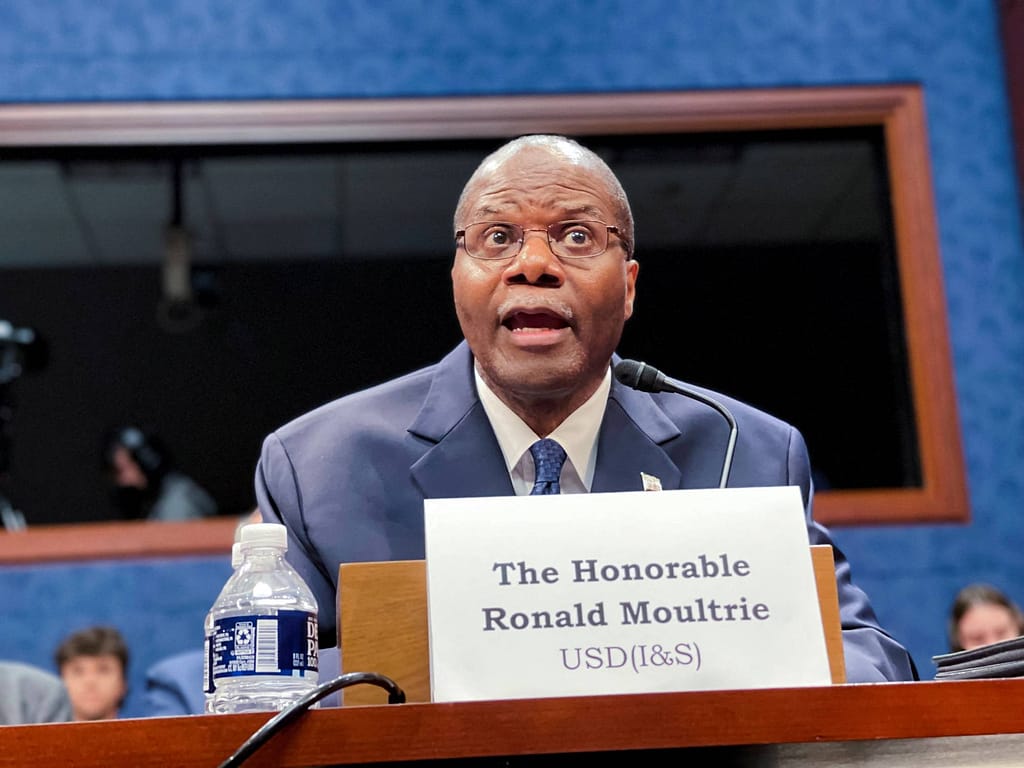
May 2022 — House Intelligence Subcommittee, “Unidentified Aerial Phenomena.” The first open public UFO hearings in more than 50 years. Key witnesses: Ronald S. Moultrie (Under Secretary of Defense for Intelligence and Security) and Scott W. Bray (Deputy Director of Naval Intelligence). Bray testified that the military’s internal database of incidents had grown to over 400. Two declassified videos were presented, one showing a spherical metallic object zipping past an F/A-18 cockpit window with apparent ease. Conservative and bureaucratic in tone, but it established the framework for AARO.
July 2023 — House Oversight Committee, “Unidentified Anomalous Phenomena: Implications on National Security, Public Safety, and Government Transparency.” Witnesses: David Grusch, Ryan Graves, and David Fravor. The shocker. Grusch testified that there had been a multi-decade crash retrieval and reverse-engineering program involving partially intact UAP craft, and that “biologics” had been recovered which were non-human. Fravor and Graves gave first-hand testimony to their personal experiences as military pilots.
November 2024 — House Oversight joint subcommittee, “Unidentified Anomalous Phenomena: Exposing the Truth.” Witnesses: Luis Elizondo (former head of AATIP), Admiral Tim Gallaudet, and journalist Michael Shellenberger. Elizondo testified that “we are not alone in the cosmos” and that there was a global secret arms race to reverse-engineer recovered UAP technology. Shellenberger testified about a top-secret Special Access Program called “Immaculate Constellation,” created to consolidate UAP sensor data away from traditional military channels. Gallaudet testified that UAP videos and other sensor data mysteriously vanished from his secure government computer system.
September 2025 — House Oversight Task Force, “Restoring Public Trust Through UAP Transparency and Whistleblower Protection.” Focused on concerns by military personnel that they would be subject to recriminations or prosecution for reporting anomalous events. Representative Eric Burlison unveiled whistleblower footage dated October 30, 2024, showing an MQ-9 Reaper drone tracking an orb off the coast of Yemen. A second Reaper fired a Hellfire missile at it. The missile appeared to strike the object, which then continued — debris tumbling — apparently unimpeded.
New Patterns: Undersea, Nuclear, Non-Human
Along with the testimony, new patterns emerged.
The phenomenon is not only in the air. It is also under the sea. Naval and military witnesses have described enormous craft moving underwater at speeds far beyond publicly known human technology. There are reports of craft disappearing into the sea, emerging from it, and accelerating to very high altitudes.
The model widened. The old model was simple: UFO means spacecraft; spacecraft means aliens; aliens means extraterrestrials from another planet. That model may still be partially true. But the modern discourse expanded. The term NHI — Non-Human Intelligence — entered official and journalistic use. The discourse widened from “these are extraterrestrials” to the more unsettling possibility that these may be other entities operating in, around, or alongside our world.
Nuclear sites. UAP have frequently been reported around nuclear missile sites, with stories of them interfering with missiles — both shutting them off and turning them on. The pattern began to look less like alien visitation and more like controlled surveillance by unknown parties.
By 2023 and after, the story had become bigger than “Are they from another planet?” The better question had become: What form of intelligence could produce these events, interact with human military systems, remain partially hidden, and yet allow itself to be seen just enough to force a slow institutional response? And more importantly, why would it do that?
The shift from UFO to UAP to NHI is not just bureaucratic linguistics. It implies a profound conceptual change.
The Disclosure Era in 2026
The official process remains contradictory and frustrating. AARO has publicly said it has found no verifiable evidence of extraterrestrial technology in the historical record it has reviewed. At the same time, the government continues to release materials, investigate cases, brief Congress, and maintain dedicated UAP infrastructure. That tension is not a reason to dismiss the subject. It is the subject.
It is quite clear that our leaders are struggling with how to disclose this anomaly to us. Recent reports claim that evangelical leaders have been called to Washington to discuss how religious communities might process the announcement of NHIs. Another term now constantly in use is “ontological shock” — a phrase as nebulous as it is provocative. There are also hints of an active conflict within the government, with one faction wanting to disclose and the other not. What they seem to have compromised on is this steady drip of information from them to us, hence the recent disclosure file drops.
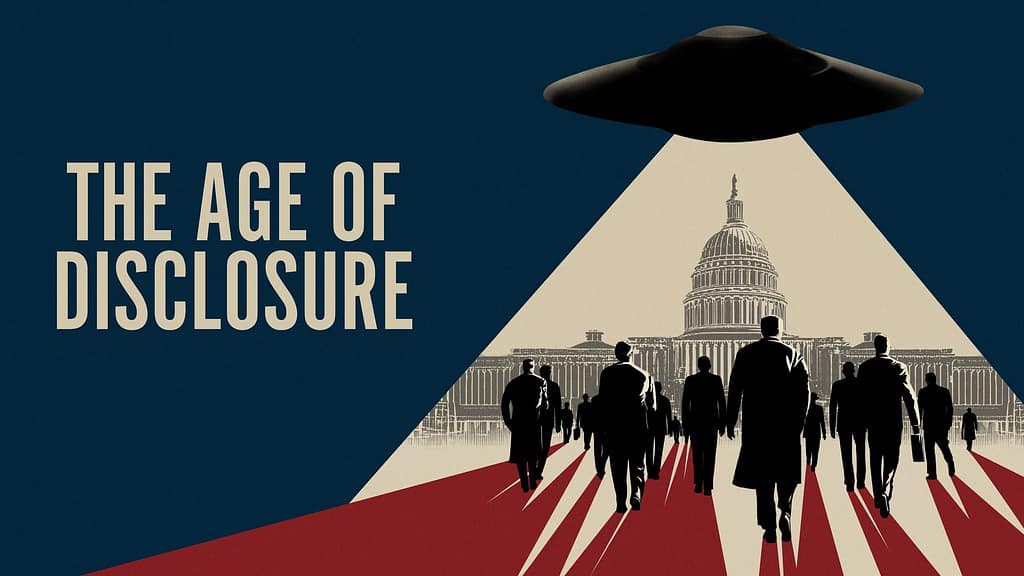
In 2025, director Dan Farah released The Age of Disclosure, a 109-minute documentary featuring 34 senior members of the U.S. government, military, and intelligence community, including Secretary of State Marco Rubio, former Director of National Intelligence James Clapper, and former AATIP head Luis Elizondo as narrator. The film argues for an 80-year cover-up and a secret arms race among major nations to reverse-engineer non-human technology. Whatever one makes of the claims, the cast list alone is the message: this conversation is no longer a fringe one.
In 2026, the process entered a new phase. On May 8, the Department of War launched war.gov/ufo, an official UAP disclosure portal operating under a program called PURSUE — the Presidential Unsealing and Reporting System for UAP Encounters. The first tranche included 162 declassified files: 120 PDFs, 28 videos, and 14 images, curated from the FBI, DoD, NASA, and the State Department. A second batch followed within weeks. The archive is opening on a rolling basis.
The cultural effect is not cautious, even if the official interpretation is. The archive is opening, and the public is being asked to absorb what previous generations were trained to laugh at.
What’s Actually Being Disputed Now
That is the real story since 2017. The government has not given the public a single clean answer. Instead, it has allowed the question itself to become legitimate.
For most of the postwar era, the UFO question was managed through ridicule. After 2017, it has increasingly been managed through process. And process is how modern states metabolize reality — whether it is recognizing a state, opening classified archives, or admitting the possibility of NHIs.
This is why the 2017 moment matters so much. It did not begin the phenomenon. It did not even begin government interest in the phenomenon. That history goes back decades, through Blue Book, radar cases, pilot encounters, nuclear-site incidents, intelligence files, and classified rumor. What 2017 did was mark the point where the old containment system failed in public.
Since then, the UAP subject has moved through a sequence of irreversible thresholds. We’ve gone from “only crazy people and cultists believe in UFOs” to “here’s this week’s official U.S. government UFO video release.”
The mainstream media reaction has been slow and uneven. The New York Times, despite originating the 2017 story that began the whole thing, barely acknowledges it now, despite four congressional hearings. Broadcast television has been somewhat better — see this 2021 60 Minutes piece.
We are now living through a managed transition from ridicule to recognition. The remaining dispute is not whether something is happening. Something is plainly happening. The dispute is over ontology, control, secrecy, and meaning.
Are these craft? Probes? Drones? Biological, post-biological, interdimensional, cryptoterrestrial, ultraterrestrial, or something for which we do not yet have language? There are also religious interpretations circulating in and around Washington, including claims that some figures view the phenomenon in literal biblical or demonic terms.
Are they visitors, neighbors, custodians, or watchers? Has the state concealed knowledge, concealed ignorance, or concealed both? And why is the public being brought into the conversation now?
Those questions lead backward into the lore and forward into the unknown. But the first fact is this: since 2017, the UFO subject has crossed the institutional threshold. It is no longer merely a fringe belief. It is now a military, intelligence, scientific, congressional, and civilizational reality.
The Disclosure Era has begun.
Part 2 of this series — covering the deeper history of the phenomenon before 2017 — is coming soon. Subscribe to the newsletter to be notified.